Category: Diary

  • Maybe the keyword that changes your life is “moving”…

    I came across a book by Kenta Nagakura titled “People Who Move Around Succeed” (Idō suru hito wa umaku iku) at a bookstore, and I decided to read it.
    In this post, I’d like to share my impressions.

    “People Who Move Around Succeed” by Kenta Nagakura

    Overall impressions

    First of all, this book is remarkably easy to read. I say that because I’ve never been much of a reader and I know I read quite slowly, yet I got through this one with little effort.

    Normally it takes me two or three days to finish about 200 pages, and more often than not I lose interest partway through and give up entirely.
    Yet even I managed to read this book in about three hours in total.
    Honestly, I was pretty surprised.

    I’ll try not to give too much of the content away, but sharing my impressions requires at least a minimal summary, so if you want to go in fresh, you may want to skip this post.

    Centered on “movement,” the book’s key concept, it is essentially saying: “If you want to change your life, move!!!” (to put it far too simply).

    As the author notes in the preface, this is not a philosophy everyone will accept, and it will surely draw criticism.
    Still, it resonated with me, and since this is one legitimate way to live, I think it will fit some readers perfectly.

    There is nothing dubious about the content; it reads as though the author is earnestly setting down what he genuinely believes.

    Also, a common shortcoming of self-help books is that you understand what you ought to do but get little detail on how to actually pull it off. I found there was very little of that problem here.

    Because it gives a solid answer to “So what do I do starting tomorrow?”, I think many readers will come away feeling glad they read it.

    Where I agree and where I don’t

    The book has six chapters, and my personal take is that I broadly agree with all of them except Chapter 4, which contained a fair number of points I couldn’t quite accept.

    Chapters 1 through 3 were written with real clarity.
    (What follows may come across as presumptuous, so please bear with me.)

    The critical view of society, and the fact that the author writes about things both from a first-person perspective and from a bird’s-eye view, made the book very easy to follow.

    It touches on things we tend to forget in daily life, and its perspective makes you think, “Yes, that’s exactly how it looks from the outside.” It prompted me to reflect on my own situation—whether I should change my current life, what I’m missing, and so on.

    Chapter 4 lays out concretely what one should do, but the advice stems from the author’s own vantage point, and my honest impression is that it’s hard to apply directly to myself.

    That said, it’s only hard to apply as-is; you can simply shift perspective, and in fact it works well as a prompt to come up with your own alternative options.

    As for the rest, my impressions are the same as for Chapters 1–3.

    My own thoughts after reading

    The title makes clear that “movement” is the theme, and it was precisely because the title resonated with me so strongly that I bought the book at the store.

    I also think one reason the book was such an easy read is that my own thinking is quite close to the author’s.

    You could call it a critique of living a conventional life.
    My own motto is that I want to live an enjoyable life and not the same life as everyone else, so I hope to do whatever it takes to avoid falling into a conventional way of living.

    I think everyone has had this thought at least once, and has probably acted on it, but the book made me consider how our social structures and culture make it hard to do so.

    Lately I’ve been questioning whether that is actually good or bad.

    Books about how to succeed tend to say, quite bluntly, that Japanese culture is no good and that you should go abroad. In other words, they urge you to break free from being pacified into conformity.

    This book is more logical, and of course it doesn’t go quite as far as that.
    Still, in the end it does seem to suggest that breaking away from being an ordinary person is the path to success.

    And that is probably true.
    So-called successful people are a minority, so becoming one requires breaking away from the majority.

    That said, it is also a fact that society functions thanks to the culture and mindset of the majority.
    Why is Japan so safe? Why is general education so widely shared here?

    I think it is precisely because of the way Japan is—its culture, its systems, its ways of thinking.

    That’s why, although we tend to focus only on how Japan compares unfavorably with other countries, I’ve come to realize recently that there must be reasons why things turned out this way, and advantages that come with it.

    In this book, the author also says that living abroad allowed him to see both the good and bad of Japan and the good and bad of other countries.

    It’s obvious, but I think it’s something we easily forget.

    Rating

    My rating for this book is

    ★★★★☆

    .

    To change your life, the first step is simply learning that such a way of thinking exists.
    On that basis, this book is very easy to understand, and I think it also offers clear guidance on what to do next.

    That said, for people who don’t want to change their lives, the information may not be necessary.
    Since I can’t quite recommend it to everyone, I personally settled on four stars.

    It’s a very good book, and I personally enjoyed reading it a great deal.

  • My First-Ever Hair Removal — in Korea!!

    Beard hair removal is extremely expensive in Japan.
    And having to go back again and again is another painful part of it.

    In Korea, a country famous for its beauty industry, hair removal can apparently be done far more cheaply than in Japan. I had never had any hair removal done before, so on my first trip to Korea I decided to try it for the first time!!

    The Process and the Price

    I had the treatment done at a place called Personal Beauty / GU Clinic in the Gangnam district.
    I made the reservation using the smartphone app Gangnam Unni.

    Here is the link

    I used Gangnam Unni to search for beard hair removal for men in Seoul, but there were only one or two other places offering it, so choosing wasn’t hard at all.

    At the time of booking, the price was 500,000 won for five full-face sessions (about 50,000 yen).
    So cheap!!!

    Two days before, I applied for an online consultation through the app to make a reservation.

    The moment I tapped “online reservation,” messages started arriving in Japanese.

    The app seems to translate the Korean automatically, so I felt no language barrier at all in making the booking.
    The messages also mentioned that if communication became difficult they would use a translation device, which gave me the impression they were used to accommodating foreign patients.

    And so, with the reservation made, the day came and I headed to the clinic.

    https://maps.app.goo.gl/FjLBboA6a7Dvu6TT8

    When I got there, there were several other Japanese people around, which was a bit of a relief.
    If the worst happened, maybe someone would help me out… lol

    I told the receptionist I had a reservation, was asked to wait, and sat down in a chair.

    But even though I had arrived at my appointment time, I was kept waiting about two hours before finally being called and led into a mysterious private room.

    There, someone who appeared to be a doctor explained things to me using a translation device, and I paid.

    After that, I waited about ten minutes and was then taken to the back.

    A nurse told me she was going to apply anesthetic to my face, and then coated my face with liquid from something that looked like an alcohol spray bottle.
    (It had a slightly sweet smell, so it probably really was anesthetic, lol)

    After a while my whole face felt a bit tight, and just as I was thinking the anesthetic must be kicking in, a fairly young male doctor called me into the treatment room.

    There, the laser was applied.
    Maybe because of the anesthetic, it barely hurt at all except where my beard is thick, and even there it only stung a little.
    It was quite different from what I’d heard about hair removal in Japan—perhaps the use of anesthetic is what sets it apart.

    That said, there was a strong burning smell, and they kept blowing air on my face the whole time.
    Just as I was starting to muse about whether the lasers here are stronger than in Japan, I was told, “All done!”

    It honestly felt like about 30 seconds—I thought, wow, that was fast.

    After that I washed my face, headed out, and went on enjoying my trip to Korea.

    The Results Afterward

    For about a week, hardly anything happened, but by the second week I started noticing spots where my beard looked thinner.
    Actually, “not growing at all in places” would be the more accurate description.
    I was genuinely surprised!

    So it seems the treatment really does work!

    I have four more sessions at that clinic, and they told me to come back every month and a half to two months.

    I figure I’ll just go whenever I can, tacking it onto future trips to Korea.

    Overall Verdict

    Apart from the excessive wait, I had no complaints at all. Communication was a bit halting, but with the ultimate weapon that is a translation device, any problems got sorted out just fine.

    When I mentioned the long wait in a review, the clinic replied with an apology and said that this doesn’t happen much on weekdays, so I should come on a weekday next time!

    Maybe I’ll go on a weekday from now on.

    It was a pretty interesting experience overall—definitely give hair removal in Korea a try.

  • When on earth does blogging actually start paying off?

    When on earth does blogging actually start paying off?

    Blogging is one of the most common side hustles out there, but how many people actually make money from it?
    And how much can you really earn?

    Most of the information in books and online comes from professional bloggers or people who write posts in earnest. There’s almost nothing out there from people who just casually keep a blog.

    When I set up this blog, I went with WordPress, but it costs money, and I remember wondering when I would ever break even.
    I’m still in the red, but revenue has finally started to trickle in, so I’d like to write about where this blog currently stands.

    Where the blog stands

    First, some background: my first post went up in March 2021, and as of writing this in September 2022, the blog has 46 posts.
    That works out to about four posts a month. The quality varies quite a bit, and most of them are things I can write in about an hour.

    The main genres are programming and everyday life.

    The most recent traffic figures are about 3,500 pageviews and about 2,500 visitors per month.
    My most popular post gets around 35 views a day.

    What I’ve noticed is that programming-related posts are in high demand, and that even with few visitors, the same people come back repeatedly, which racks up pageviews.

    Everyday-life posts, on the other hand, are mostly diary-style pieces that don’t turn up in searches, so they get far less traffic.

    Where the income stands

    Right now I mainly use Google AdSense and Amazon Associates.

    I was approved for Google AdSense in May 2022 (I think I had around 35 posts at the time), and total revenue so far is 5,000 yen.

    Amazon Associates has brought in 0 yen.

    So the blog’s total income to date is 5,000 yen.

    As for why, my site doesn’t really do Amazon product reviews, so I hardly ever post Amazon links in the first place.
    Which means it might as well not be there at all…

    Thinking about revenue rates

    With Google ads, 100 impressions earn about 1 yen, and a click earns roughly 10 yen on mobile and around 50 yen on desktop.

    So the return rate is fairly low, and it looks hard to earn any real income without racking up serious pageviews.

    With Amazon Associates, I believe the commission is somewhere around 3–10% of the item purchased (apologies if I’ve got that wrong).
    So if someone buys a 10,000 yen item, you could earn up to about 1,000 yen.
    It’s a program where you can aim for decent income even without huge traffic.

    Apparently, for most people who make money blogging, affiliate programs like Amazon bring in more than Google ads do.

    Running costs

    In my case, running the blog is expensive: 15,000 yen a year.
    Most of that goes to the server contract.

    If you shop around, there are servers that cost about 5,000 yen for three years with lower setup fees, so that’s better value for money.

    I’ve stuck with my current host partly because I’m not sure how to migrate, and partly because the server has a good reputation.

    At this rate, who knows when I’ll actually turn a profit.

    That said, even doing it pretty haphazardly, just sticking with it earns more than I expected.
    My takeaway is that blogging rewards you in proportion to how seriously you take it.
    Also, pageviews generally don’t drop off suddenly, so as long as you keep writing reasonably well, the numbers keep climbing.

    More than anything, blogging is genuinely fun, so I’d encourage everyone to give it a try, even for free.

  • I Visited Waseda University! Campus Life in the Heart of the City

    I Visited Waseda University! Campus Life in the Heart of the City

    I visited Waseda University for the first time, for a conference.
    Waseda is famous alongside Keio as a top-tier private university, but I’d hardly ever seen photos of it — to the point where I had almost no mental image of the campus at all, or even whether it really existed.

    There was a conference at Waseda University, and I was really looking forward to finally seeing the famous Waseda campus for myself.

    My first impression of Waseda University: what a great atmosphere!
    It sits close to busy areas like Takadanobaba, yet it isn’t just a university crammed into an office building — it has a proper campus with real character.

    Impressions of Waseda University

    Here are my rough impressions of Waseda University.

    • Lots of stylish cafés
    • Lots of international visitors and students
    • Spacious for central Tokyo (though still compact compared to universities outside the city)
    • A European feel

    Compared with the University of Tokyo, Kyoto University, and the other former imperial universities, the campus grounds are indeed small, and the buildings struck me as tall and vertical.
    The buildings stand fairly close together and there aren’t all that many of them, so it didn’t feel like a sprawling campus.

    The short distances between buildings must make moving between classes easy.
    That said, with so many floors, actually getting up to your room takes a while even once you’ve arrived at the building.

    Some of the university buildings are made of brick, giving the whole place a somewhat Western feel.
    There’s a building called Building 3 where an old structure appears to be wrapped inside a new one; from the inside you can see both the characterful old architecture and the new construction, and rather than clashing, the two combine to create a wonderful atmosphere.

    Even the classrooms are stylish and chic.
    The rooms in the newer buildings are built around a black-and-white palette for a sophisticated look, while the older building doesn’t feel dated at all — it keeps the warmth of its wooden construction while remaining a comfortable space.

    Another shock was finding escalators inside the buildings.
    As someone who attends a national university, where escalators inside academic buildings are almost unheard of,
    I thought how nice it must be to move between classrooms so easily.

    I was struck by how many international people there were on campus.
    There’s a Waseda University café right in front of the main gate, and even during summer break plenty of international visitors were using it.

    The café also sells university merchandise, and it was full of Waseda Bears.
    Kind of adorable.

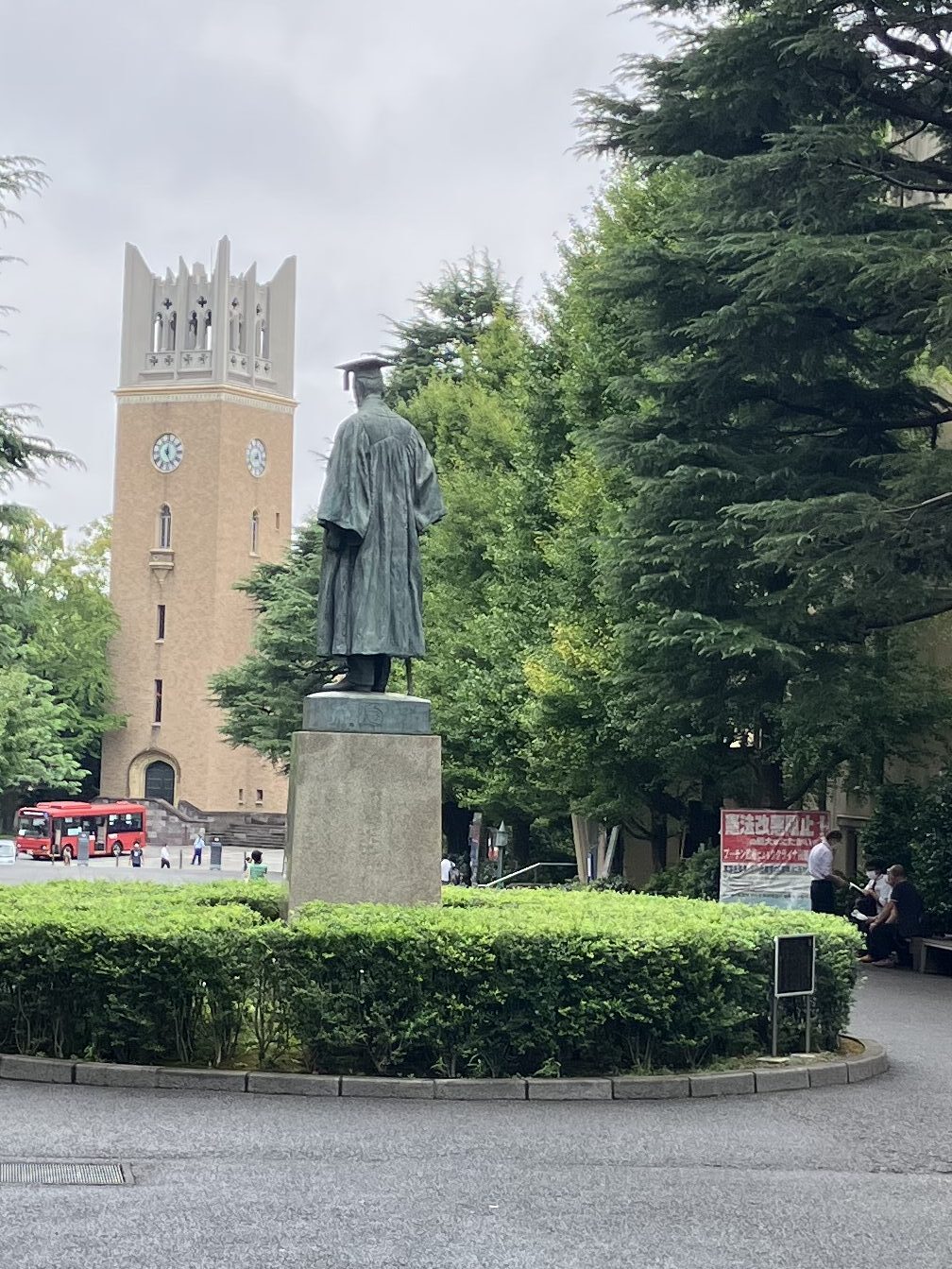
    When you think of Waseda, this is probably the image that comes to mind.

    I’d always wondered why the statue was shown from behind, but it turns out the photo is taken from inside the campus looking out toward the main gate.

    The iconic building is actually outside the main gate, and it isn’t even used for classrooms or anything like that.
    Apparently, shooting it from behind the statue is what produces that classic photo.

    The statue is of Shigenobu Okuma, and it greets you as soon as you come through the main gate.

    The atmosphere around campus

    The area around the university is full of stylish shops and restaurants — very much a student town, but one with real character.
    On the walk from Waseda Station to the university there are chain restaurants, cafés, and general goods stores, and with a Tully’s nearby, it’s easy to settle in at a café for a while.

    Just outside the main gate there’s what seems to be an ASICS Waseda University store, apparently stocking Waseda collaboration items.
    What even is this shop, haha.

    Everywhere I looked, Waseda University was beautiful and its atmosphere carefully preserved.
    It was completely different from the university I’d imagined, and I had a great time.

    Photos below

  • I Went to the Toki Mino Ware Festival 2022!!

    I Went to the Toki Mino Ware Festival 2022!!

    A friend invited me out of the blue, so I went to the Toki Mino-yaki Festival on May 4.
    This was the 46th edition, held May 3–5, 2022 — only three days. As announced on the website, there was no shuttle bus from Toki Station, so everyone seemed to be coming by car.

    I went without doing any homework beforehand, and it was incredibly crowded. A pottery festival, this packed?! But walking around the venue was great fun, and even people who don’t know much about ceramics can enjoy it.

    What is the Mino-yaki Festival?

    The most fitting description is a festival where Mino ware is sold all at once, everywhere.
    Wherever you walk: pottery, pottery, pottery!!!

    Along with food stalls, knives, and glassware, there was far more than just tableware — ornaments, accessories, and plenty of other appealing items.
    Prices ranged from expensive pieces to deeply discounted bargains, so it’s a truly great place if you have a particular dish in mind.

    There are apparently famous potters and brands too; a quick Google search turns up Instagram accounts and roundup blogs.

    My personal impression was that Mino ware (though this isn’t unique to Mino ware) has a strong association with Japanese-style tableware. I was after Western-style pieces at the time and worried I wouldn’t find any, but there was plenty of Western-style tableware as well. There were even dishes that made me go, “Wait, they make this too?!” It’s fun just to look, and a place where you can find a favorite piece.

    Conditions and schedule on May 4

    I left Nagoya around 10 a.m. and headed to Toki on local roads.
    As I got close, there was a 4-kilometer traffic jam leading to the venue parking lot.
    It was so congested that I couldn’t get into the lot — I arrived nearby at 11:30 but only actually parked at 12:50.
    (Some people apparently arrive the day before or head out first thing in the morning. Leaving Nagoya early enough to reach Toki in the morning is pretty tough…)

    The venue is quite large, with so many shops that two hours wasn’t enough to see it all.
    The parking lot is the TOTO factory lot rented out for the event, so it’s spacious with plenty of capacity.

    Google mapより

    The venue is enormous, but there are relatively few vending machines or places selling drinks, so I’d recommend bringing your own.
    If it’s sunny, you’ll be walking around in real heat and risk heatstroke.
    There’s little shade, and it takes a lot out of you.

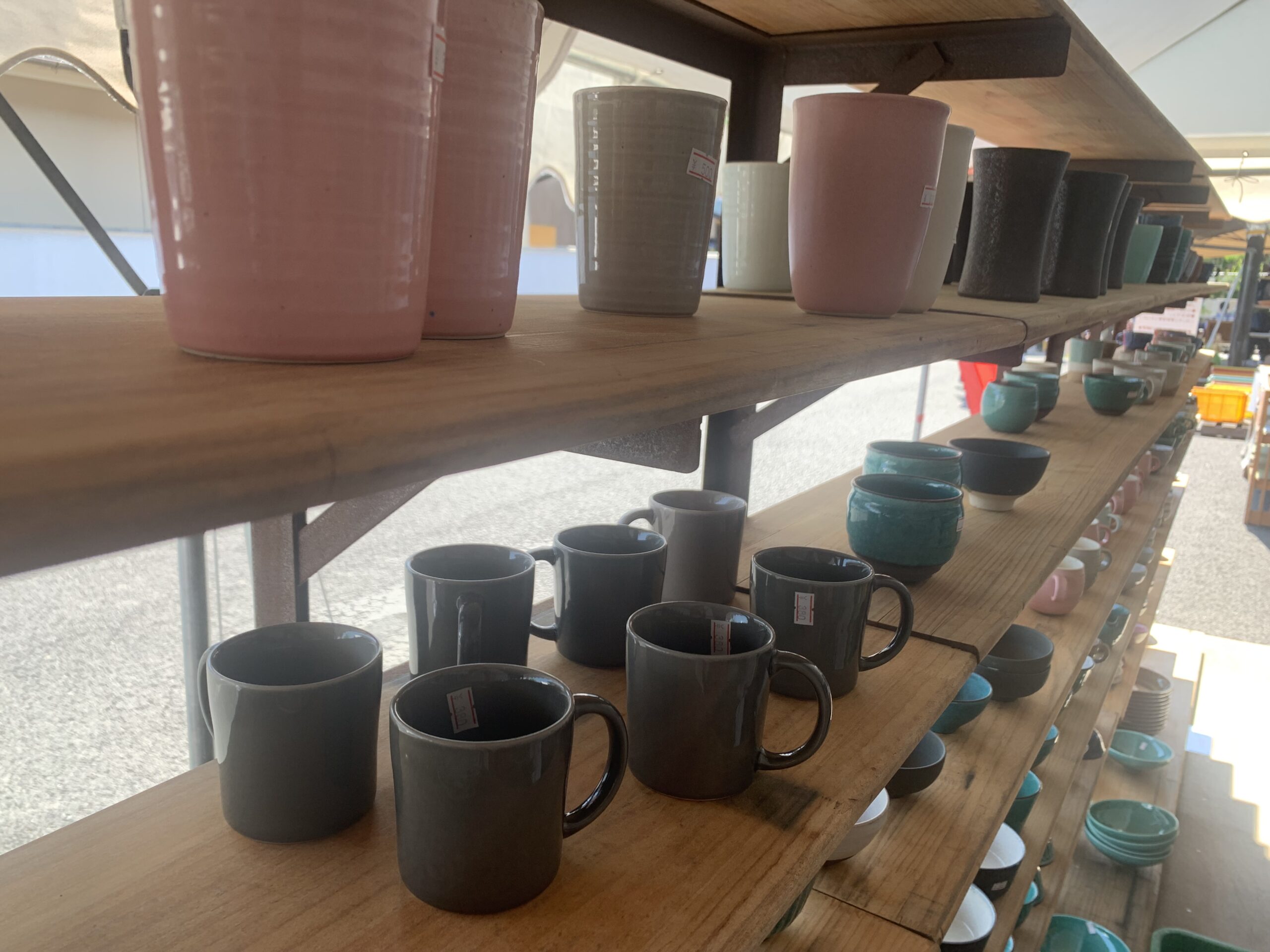
    The individual shops set up under tents have distinctive plates, cups, and ornaments, mostly priced around 1,000 to 3,000 yen.
    Pricier items can run over 5,000 yen.

    The large-scale shops set up in warehouse-like spaces were very cheap — some items started at 100 yen apiece.

    Even the cheap ones have perfectly good designs, and they’re genuine pottery.
    Being able to get Mino ware at those prices is a real treat.

    The solo-artist booths carry a lot of distinctive tableware, so I thought they’d be great not just for yourself but as gifts for friends and family.

    What I personally loved was the abundance of factory seconds.
    These are pieces with small flaws from production — minor scratches or uneven glazing — and even when the defect is tiny, they’re sold at very low prices.

    Some of the flaws are in places that don’t affect durability and even start to look like character, so I picked up nicely designed tableware for very little.

    In the end I bought a large black board-like plate, two blue cups, and a coffee roaster (a ceramic one that roasts with far-infrared heat, I think).

    I want to go again next year.

    Who would I recommend it to?

    If you’ve just moved and need dishes, if you’re really into tableware, or if you have a specific piece in mind, it’s a great opportunity and I’d definitely recommend it.

    Even if you’re not into tableware, you’ll gradually get interested and come across things that make you think, “Oh! I might want this.” (The friend I went with had zero interest, but ended up buying something in the end.) So it’s worth a visit.

    That said, it gets extremely crowded, so go with some kind of plan — or stock up on snacks in the car and just inch along!!
    The convenience stores along the way aren’t much help…

  • Does Getting Your Ears Pierced Hurt?

    Does Getting Your Ears Pierced Hurt?

    Introduction

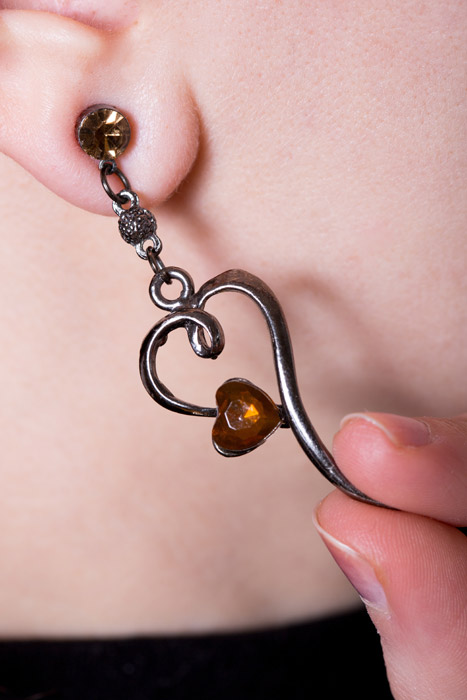
    I got my left earlobe pierced.
    I thought writing down my impressions might help anyone thinking of getting pierced, so here they are.

    Rather than doing it myself with a piercing gun, I went to a clinic and had it done there.

    I went to Clinic Bizaria, near Sakae Station in Nagoya.
    Website
    They have what’s called a Piercing Center, and it comes up as a candidate almost every time you search for a place to get pierced in Nagoya.

    What stands out is how cheap it is: one earlobe piercing, first earring included, came to 1,600 yen.
    A piercing gun at Don Quijote runs about 1,000 yen, so for roughly 600 yen more you get to consult someone and have them do it for you — a remarkable deal.

    You can also choose from a range of first earrings, so you can have something stylish in your ear right from the start.

    That said, when I looked up reviews of the Piercing Center, there were both good and bad ones, and the service seems to vary quite a bit depending on the day and the staff member.
    Putting the piercing in is basically handled assembly-line style, so there isn’t much service to speak of either way, but it might matter if you want to discuss where exactly to place the piercing.

    Getting it done

    From walking into the Piercing Center to walking out pierced took about 20 minutes in total.

    I checked in, chose an earring, and got a brief explanation.
    I knew my earlobes were on the thick side, but it’s surprisingly hard to know how thick they are compared with other people’s.
    That matters because people with thick earlobes have to watch the size when using an over-the-counter piercing gun.

    This Piercing Center stocks long-type first earrings for people with thick earlobes, which is reassuring.
    Sure enough, mine were on the thick side, so I ended up with a long-type earring.

    Once I’d picked an earring, they handed me a marker and told me to look in the mirror and mark where I wanted the hole.

    Marking the spot yourself in a mirror is surprisingly hard, and mine ended up pretty rough.
    Your ear is floppy, and the angle means you’re drawing with your arm bent, so your hand isn’t steady at all. How does everyone else manage this?

    Rough as it was, apparently it was good enough: they disinfected the spot and, on 3, 2, 1, punched it through.
    No numbing or cooling, just straight to it.
    It felt like being on a bungee platform, where things move along briskly so you don’t have time to get scared — though I couldn’t tell whether that’s the point or whether it’s just efficient.

    After the piercing, they checked the placement, and once it was fine I was free to go.
    It really was quick and painless, procedurally speaking.

    So how much does a piercing actually hurt?

    For the record, the moment of piercing hurt quite a lot, and I could feel the needle passing through my earlobe.
    Who was it that said getting pierced doesn’t hurt?

    It kept hurting moderately for about two hours afterward, and after that there was a lingering odd sensation.
    People used to wearing earrings might not mind that part, but as someone who almost never wears them, it bothered me a fair bit.

    The pain is a dull ache, entirely bearable.
    Touching the earring doesn’t hurt, and water doesn’t sting in the bath, which is a relief.

    The reason the actual piercing hurt as much as it did in my case is probably the thickness of my earlobes.
    So if your earlobes are thin, it really might not hurt.

    Anyway, it only hurts in that moment, and it’s easy to put up with when you think about the accessories you’ll get to enjoy afterward. The instant it’s done, you just think, “Oh! It’s through!” — and all the anxiety you had beforehand simply evaporates.

    I’m looking forward to thinking about which earrings to wear next.

    I want to take proper care of it so it doesn’t get infected.

  • I Visited the Starbucks at Toyota Kuragaike Park

    A new Starbucks recently opened in Kuragaike Park in Toyota City.
    Kuragaike Park is a large park with attractions such as a free zoo, and on weekends families with children come to spend the day there.

    There are grassy open areas, so you can have a picnic or get some light exercise.
    Since a Starbucks had opened in that very park, I simply had to go and check it out.

    The Kuragaike Park Starbucks faces the pond, and the pond-facing side of the store is a terrace, with steps leading down outside it.

    Inside there are various types of seating as well—sofas, two-person tables, and a large communal table—so it works for all sorts of purposes.

    On nice days you can enjoy your Starbucks outdoors: on the terrace, on the steps facing the pond, or out on the grassy lawn. It’s a Starbucks that feels at one with nature.

    Conversely, the interior is also well suited to studying a bit, reading a book, or just taking your time.

    Kuragaike Park is a big park famous as a place for kids to play, so on holidays there’s often a line.
    When I went it was around midday on a Saturday, and the line stretched outside the store.

    You do have to wait a while to get your drink, but the interior is fairly spacious and there’s outdoor seating too, so even with a line you’ll find a few open seats inside.
    The turnover is good, too ♪
    It’s really nice not to have to worry about buying a drink and then having nowhere to sit and drink it.

    Last time I went it was an extremely sunny day, and I read a book out on the terrace.
    That said, it was so bright that my eyes started to hurt, so indoors might be the better choice for reading or studying.

    My biggest concern is that Aichi Prefecture is extremely hot, with outdoor temperatures topping 40°C in summer.
    So in the height of summer, a lot of people will probably come inside just to cool off.

    The Kuragaike Park Starbucks is a wonderful Starbucks that blends right into nature.
    Do give it a visit.

  • Went to the Banksy Exhibition in Nagoya

    Went to the Banksy Exhibition in Nagoya

    I went to “The Art of Banksy: Genius or Vandal?”
    It runs in Nagoya from February 3 to June 20, and in Fukuoka from July 2 to October 31.

    The exhibition’s website is here

    Banksy is an anonymous artist based in the UK, and works attributed to Banksy can be found scattered all over the world.

    I didn’t know much about Banksy, but when I learned that he was a street artist who paints satirical images symbolizing criticism of society all around the world, I became curious about who he is and what kind of works he makes, so I went to see the exhibition.

    Photography was allowed for every piece in the exhibition, and everyone who came was taking pictures with their phones.

    This time, in order to see Banksy’s works without preconceptions, I decided to look at the works themselves and avoid reading the explanatory texts as much as possible.

    Having seen it through to the end, my impression is that, if I have to answer the exhibition’s question, Banksy is both a genius and a vandal.
    That said, while I agree that Banksy is a genius, calling him a vandal felt slightly off to me.

    This is just my personal take, but Banksy seems to feel sadness toward society and the world.
    People have lost sight of what it means to be human, and are being tossed about by the world and swallowed up by consumer society.
    The strong fail to notice the weak, and the gap only widens.
    He seems angry that people never question what they take for granted.

    That is how it felt to me.
    Because he is a genius, he has come to see the true nature of the world.
    But since he could not change the world even by becoming a politician, he appeals to the world as an artist instead.

    Since I know almost nothing about Banksy, I have no idea whether this reading is right.
    I may well be completely off the mark.

    Still, while I felt a strong will in the works, I didn’t sense the violent side implied by the word “vandal.” What came through was sadness and Banksy’s own strong will — and perhaps to conceal that, or perhaps out of humor, he expresses it in the form of satire.

    Honestly, for nearly half of the works I had no idea what they were trying to say.
    But with the other half, something came through naturally.

    It is precisely because Banksy is a genius that he can create humorous, critical satirical works.
    I also thought his technical skill as a painter was outstanding.

    I myself have things I want to criticize about society, things I want to speak out about, and perhaps that overlapped with Banksy’s works and led me to interpret them this way.

    I think anyone who sees Banksy’s works will feel something from them.
    I’m very curious how Banksy’s works look through your eyes.

  • Trouble with a Mercari Transaction: A Third Solution — the Partial Refund

    Trouble with a Mercari Transaction: A Third Solution — the Partial Refund

    Trouble is bound to happen sooner or later when you buy and sell on Mercari.
    I’ve made over 100 transactions myself, and the other day I ran into my first real problem.

    What I bought was a coffee machine, and some of its functions didn’t work.
    When I contacted the seller, they told me they had checked that it worked properly before listing it and that it had been fine.

    Mercari’s FAQ has an entry for “the item that arrived is different from the description / is broken.”
    However, it basically says that the seller and buyer should discuss the matter between themselves, and for returns it describes agreeing on who pays the return shipping and then cancelling the transaction.

    In other words, the transaction guide makes it feel like your only options are to return the broken item or accept it as is.

    Depending on the item, though, only part of it may be broken while everything else works fine.
    And if that particular function isn’t especially important to you,
    you might feel that the full listing price is a bit much, but a discounted price would be acceptable.

    In that situation, you can arrange a partial refund.
    You can’t do it unilaterally, but if you and the other party reach an agreement, you can contact Mercari’s support team.

    In my case, I proposed a partial refund and sent an inquiry to the support team.
    They replied: “Please have the buyer and seller decide on the refund amount, then contact us again through the inquiry form with that amount.”

    Once we agreed and settled on the refund amount, I reported it, the partial refund went through without any issues, and I was able to complete the transaction.

    The support team responded very quickly—from the moment I told them I wanted to arrange a partial refund, it took only about a day to decide the amount and receive the money.

    No matter how careful you are, problems can still happen with Mercari transactions.

    When something goes wrong on Mercari, you have to negotiate with the other party and settle it yourselves; the fact that Mercari has no fixed protocol or procedure was quite confusing at first.
    In my case, the other party was very reasonable, so resolving the issue went very smoothly.

    Apparently, if you can’t reach the other party, you can also ask Mercari’s support team to force the transaction to close.

    Incidentally, for the coffee machine I bought, I was refunded about 40% of the purchase price.
    But after the transaction closed, I took it apart to see whether I could fix it and found a water leak. I decided it was too dangerous to use and ended up throwing it away.

    In the end, maybe I should have just returned it…

  • I keep losing track of which screw goes where!! Solved with a simple idea ☆彡

    I keep losing track of which screw goes where!! Solved with a simple idea ☆彡

    Whether you’re swapping a computer’s HDD for an SSD, reapplying thermal paste, or trying to fix a broken appliance or piece of furniture yourself, it’s all too easy to lose the screws.

    Once a screw is gone, you have to buy a replacement at a hardware store, and finding one that fits perfectly is no small feat.
    I lost a screw myself while trying to repair a Switch Pro Controller, and ended up having to go buy one.

    In recent years, electronic components circulating in the Chinese market have become available through AliExpress, Wish, and similar sites, and junk items are easy to pick up on flea market apps like Mercari. As a result, far more people are trying their hand at repairs themselves.
    With COVID-19 keeping everyone at home, I think this trend has only accelerated.

    That said, keeping track of your screws is a basic part of fixing anything—and one of the most important.
    So I’d like to share how I manage screws when repairing junk items.

    You can make this with an adhesive-backed magnet sheet from a hundred-yen shop and a clear tray.
    When I bought mine, the magnet sheets were in the stationery section and the clear trays were in the storage section.

    Just cut the magnet sheet to a suitable size and stick it on—that’s all there is to it.

    Stackable trays work even better: stacking them in the order you disassemble things makes it easy to tell which screws came from where.
    Another selling point is that you can keep small parts alongside the screws.

    It’s easy to put together, so give it a try.